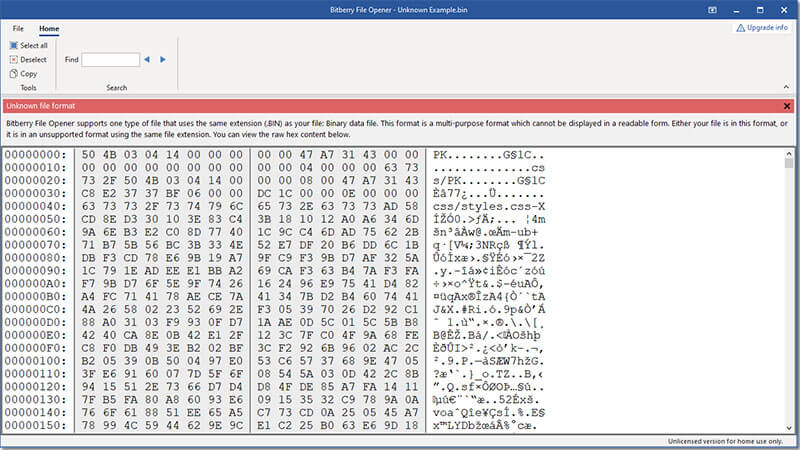
Bitberry File Opener, a best-in-class file handling tool for Windows, enables you to view, and print BIN files on your PC.
Supported .BIN file format
Binary data file
The first step is to download the setup program. It contains everything you need to handle BIN files. There are no 3rd-party dependencies.
Once downloaded, double-click the file (usually named BitberryFileOpenerSetup.exe) to start the installation process. This is a one-time thing.
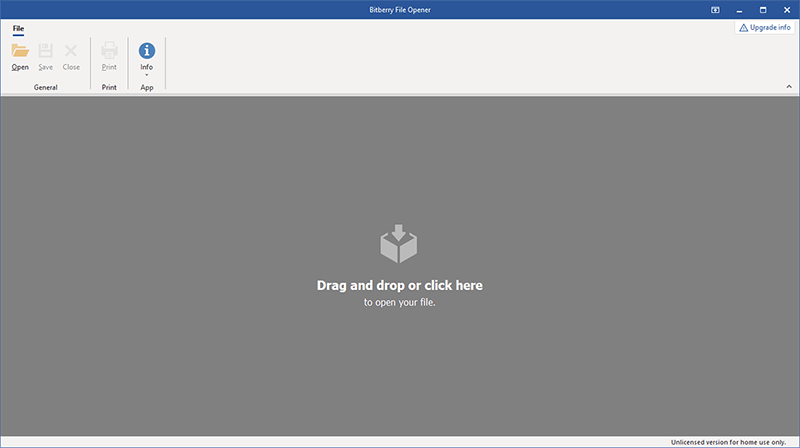
Run Bitberry File Opener and select Open from the File menu to select your file.
You can also drag your file and drop it on the Bitberry File Opener window to open it.
You can associate Bitberry File Opener with any supported file type so they open when you double-click them.
The BIN file extensions is used for different types of files. Bitberry File Opener will try to detect the format and display it, otherwise it will display a "hex dump" (raw content) of the file.
Copy part of the file to the clipboard as hex string or binary blob, print it, or save it.
Unisoc’s newer chips (T606, T616, T618, T700, T820) require updated authentication certificates. Free Hydra versions from 2021–2022 will not work on Android 12/13/14 devices.
The UniSoc module supports a wide range of chipsets (SC7731E, SC9863A, Tiger T606, T612, etc.) for functions like FRP removal, factory resets, and IMEI repair. General Connection Guide: Open the Module: Run the Hydra UniSoc tool. Select Device/CPU: hydra unisoc tool download
Many beginners ask: “Why can’t I just use ADB or Fastboot?” Unisoc’s newer chips (T606, T616, T618, T700, T820)
In the rapidly evolving world of mobile repair, technicians and enthusiasts alike are constantly on the lookout for tools that offer precision, versatility, and speed. One such powerhouse is the , specifically its dedicated module for UniSoC (formerly Spreadtrum) chipsets. Whether you're dealing with a forgotten screen lock, a bricked device, or a lost IMEI, the Hydra UniSoC module has become a go-to solution for professional-grade mobile servicing. What is Hydra Tool UniSoC? General Connection Guide: Open the Module: Run the