
Cag Generated Font __hot__ File

describes a diffusion model approach that separates font generation into structure construction, font transfer, and refinement stages.

As the technology behind CAG generated fonts continues to evolve, we can expect to see even more innovative applications and integrations in the world of design. From dynamic, context-aware typography in digital interfaces to custom fonts for emerging languages and dialects, the future of typography is undoubtedly exciting and full of possibilities. cag generated font

Generative AI in typography often struggles with "hallucinations"—where a model might add extra legs to a letter or fail to match the curve of a specific style. Incorporating a CAG-like approach helps by: The Computer Vision Foundation Style Pre-loading describes a diffusion model approach that separates font

This article dives deep into what CAG generated fonts are, how they differ from standard digital fonts, the technology that drives them, and why they matter for the future of branding, accessibility, and design. In a CAG system where every letter is

In a traditional font, the "A" and the "B" share a unified design language (stroke weight, contrast, serif style). In a CAG system where every letter is generated independently based on a prompt, maintaining visual coherence across an entire alphabet or word is difficult. If the word "Ocean" is generated, the "O" and the "N" must look like they belong to the same "water" family, not five disparate ideas of water.

To appreciate the innovation of AI in this space, one must first understand the CAG classification. This acronym refers to three distinct, historically rich families of type:

Modern Web Support

AntView is built as an ActiveX wrapper for Microsoft Edge WebView2, which allows legacy applications to access modern web technologies inside their existing framework without requiring a complete rewrite.

Seamless ActiveX Compatibility

AntView is designed as a  replacement for the traditional ActiveX WebBrowser control, allowing legacy applications to upgrade from Internet Explorer to Microsoft Edge WebView2.

Easy Integration

 AntView makes integration simple, fast, and low-risk, ensuring a smooth transition from outdated ActiveX controls to modern, secure WebView2 technology without major disruptions.

AntView is an ActiveX wrapper for the WebView2 control that is easy to use from any programming language cag generated font

PLANS AND PRICING

Per Developer Licensing

  • Single developer seat that is valid for AntView version 2.x
  • Now for only EUR 349,- (excluding VAT)
  • Renewal of the subscription is EUR 149,- The subscription must be renewed within 3 months after the subscription expires. You cannot apply an expired license to a version of AntView that was released after your subscription expired.

The prices above are without VAT or sales tax.
If you have multiple developers working on a product that uses our control, then you need a developer license for each developer working on that product.
You do not need a license for your test server, or for your QA personnel that does no development.


Support is provided to the licensed developer(s), not end users.
 The subscription covers a license for any new version of AntView which is released during the subscription period.

Site License

A site license comes at EUR 9900,- (excluding VAT) and can be used at a single named location. The site license covers an unlimited number of developers at this location.

For companies with many developers working on a product that utilizes the AntView control, a Site License can be acquired.


Enterprise License

For companies that need enterprise support, such as onboarding or specific contracts that need to be filled out, an enterprise license is available.


An enterprise license costs EUR 39500,- (excluding VAT) and covers all developers of a single organization worldwide.

Embedded License

Hardware devices where AntView is embedded in the hardware product, such as HMI/SCADA and IoT devices need a license for each host.

An embedded license is currently available at a 33% discount for EUR 199,- (excluding VAT) per host.

*All licenses come with a one year update subscription.

The control will continue to work even once the subscription has expired, but you won’t be able to get support for it, run an updated version of the control released after your license expired, or be able to renew for the discount price.

Future-Proof Your Applications – Keep Legacy Software Running with Modern Web Tech cag generated font

describes a diffusion model approach that separates font generation into structure construction, font transfer, and refinement stages.

As the technology behind CAG generated fonts continues to evolve, we can expect to see even more innovative applications and integrations in the world of design. From dynamic, context-aware typography in digital interfaces to custom fonts for emerging languages and dialects, the future of typography is undoubtedly exciting and full of possibilities.

Generative AI in typography often struggles with "hallucinations"—where a model might add extra legs to a letter or fail to match the curve of a specific style. Incorporating a CAG-like approach helps by: The Computer Vision Foundation Style Pre-loading

This article dives deep into what CAG generated fonts are, how they differ from standard digital fonts, the technology that drives them, and why they matter for the future of branding, accessibility, and design.

In a traditional font, the "A" and the "B" share a unified design language (stroke weight, contrast, serif style). In a CAG system where every letter is generated independently based on a prompt, maintaining visual coherence across an entire alphabet or word is difficult. If the word "Ocean" is generated, the "O" and the "N" must look like they belong to the same "water" family, not five disparate ideas of water.

To appreciate the innovation of AI in this space, one must first understand the CAG classification. This acronym refers to three distinct, historically rich families of type:
cag generated font
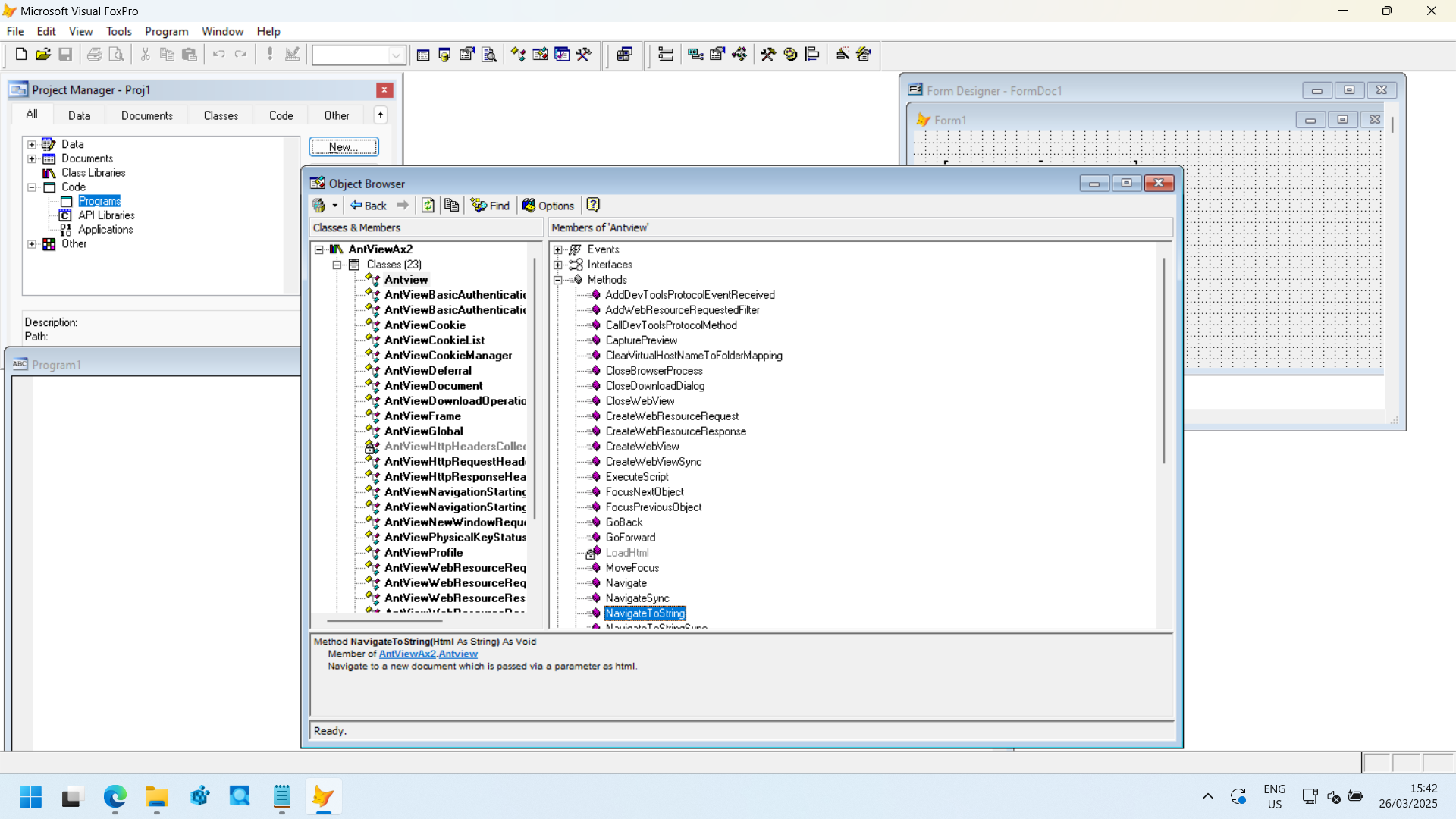
AntView in the Visual Fox Pro Environment

Why AntView cag generated font

  • Full HTML5, CSS and JavaScript Support
  • AntView uses Edge WebView2, meaning it can render web pages using the same Chromium engine as Microsoft Edge.
  • Automatic updates – Since it uses Microsoft Edge’s WebView2 runtime, AntView benefits from Chromium’s frequent security and performance updates.

Upgrade Your ActiveX Applications With The Latest MS Edge WebView2 cag generated font

Highlights in AntView 2.0

  • Built against the MS WebView2 API from April 2025
  • Adds support for Basic Authentication and Profile management.
  • Adds support to change HTML on the fly using the document interface via OuterHtml.
  • Built-in AntView About page for troubleshooting purposes without having to enable logging.
  • Embedded licensing is now available via a single license file.
  • Improved and extended examples

AntView gives you an ActiveX interface for the Microsoft WebView2 control cag generated font

  • AntView 2.0.567 release

    AntView 2.0.567 release

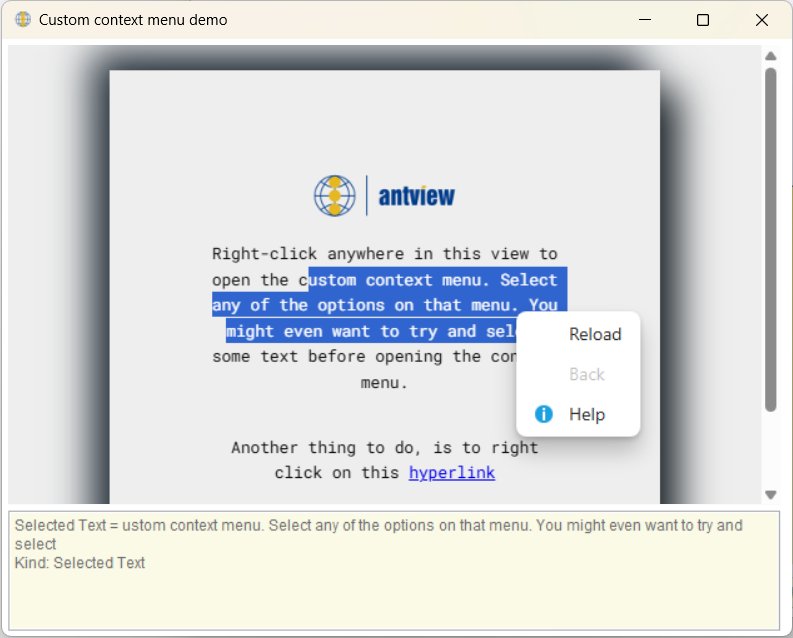
    Highlights of AntView 2.0.567 are custom context menu functionality and a synchronous cookie interface. There’s examples and help explaining these new features. New functionality has been added to the main AntView interface. The examples and help for PowerBuilder have been improved. Fixed an issue with being able to run the VB6 examples.

    Read more…

  • AntView 2.0 release

    AntView 2.0 release

    April 16, 2025 Release of AntView version 2.0.514 Uses latest API 1.0.3179.45 of WebView2 from April 2025. The RegisterAssistant application now also has command line options, so that you can use it for deployment scripts. New functionality: AntView interface:Properties: AntViewDocument interface:Methods: Events: Introduction of the AntView About Page where you can view details about the

    Read more…