

Faster than Evernote or OneNote
Zero clutter, zero setup
Better than paper notes
Never lose your ideas again
Free online sticky notes collaboration
Ideal for remote teams
Anonymous sticky notes online
 Loved by
10,000+ teams and students.
Loved by
10,000+ teams and students.
Don't let your ideas disappear. Write, organize, and share them instantly.

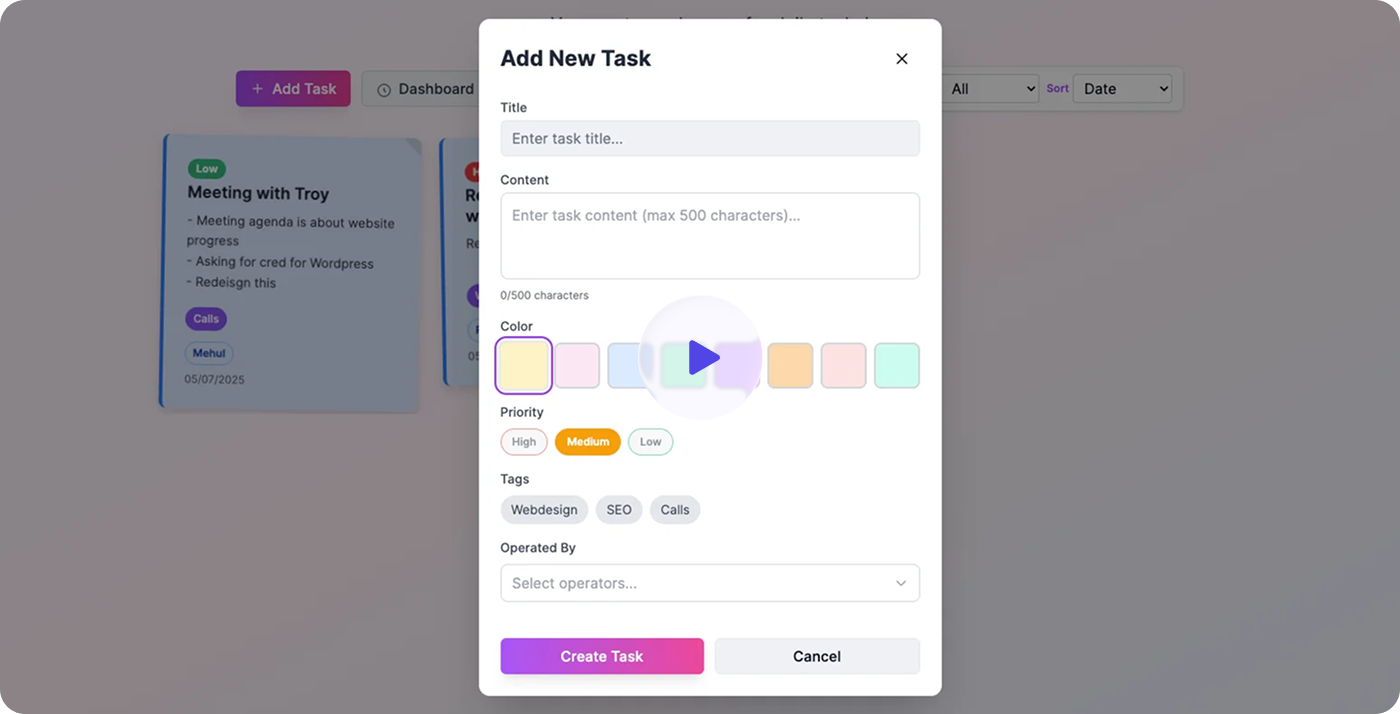
Snapynotes is more than just a sticky note website. It’s a lightweight, clutter-free quick note app designed for personal use, teams, and classrooms. Whether you need a simple online notepad or a virtual sticky note board free for collaboration, Snapynotes makes note-taking effortless.

Create unlimited digital sticky notes instantly

Share with friends, teams, or students via a simple link

Use on desktop, mobile, or tablet – anywhere, anytime

Organize ideas with colors, labels, and digital sticky notes.

Free to use, secure, and privacy-friendly
Just visit appsnapynotes.com and sign up
Add colorful sticky notes, move or organize them on your board
Import or export notes securely with Snapy notes use online anytime, no setup
Faster than Evernote or OneNote
Better than paper notes
Free online sticky notes collaboration
Anonymous sticky notes online

Designing a box culvert under involves harmonizing geotechnical (EC7) and structural (EC2) rules, with careful attention to load combinations, crack control, and durability. The 2021 amendments refined fatigue and long-term deformation checks, making designs more reliable but demanding meticulous execution. By following the step-by-step calculations for bending, shear, and soil interaction presented here, engineers can confidently produce safe, economical, and Eurocode-compliant culverts for any transportation or drainage project.
(active condition – at-rest for rigid walls may be used) ( K_0 = 1 - \sin φ' = 1 - \sin 30° = 0.5 ) Top of wall: ( p_h,top = K_0 \cdot q_earth = 0.5 \times 30 = 15 , kPa ) Bottom of wall: ( p_h,bottom = K_0 \cdot \gamma_soil \cdot (H_cover + H_culvert) = 0.5 \times 20 \times (1.5 + 2.0) = 35 , kPa ) Linear distribution. box culvert design calculations eurocode 2021
Designing box culverts to Eurocode requirements involves coordinated application of actions (EN 1991), concrete design rules (EN 1992) and geotechnical checks (EN 1997). Start with accurate site/geotechnical data, apply appropriate load dispersal for traffic, perform a frame analysis for internal forces, design reinforcement per EN 1992, and verify geotechnical stability. Final verification must use the national annex partial factors and a detailed structural/ground model. (active condition – at-rest for rigid walls may
Ready to make your notes smarter?
Designing a box culvert under involves harmonizing geotechnical (EC7) and structural (EC2) rules, with careful attention to load combinations, crack control, and durability. The 2021 amendments refined fatigue and long-term deformation checks, making designs more reliable but demanding meticulous execution. By following the step-by-step calculations for bending, shear, and soil interaction presented here, engineers can confidently produce safe, economical, and Eurocode-compliant culverts for any transportation or drainage project.
(active condition – at-rest for rigid walls may be used) ( K_0 = 1 - \sin φ' = 1 - \sin 30° = 0.5 ) Top of wall: ( p_h,top = K_0 \cdot q_earth = 0.5 \times 30 = 15 , kPa ) Bottom of wall: ( p_h,bottom = K_0 \cdot \gamma_soil \cdot (H_cover + H_culvert) = 0.5 \times 20 \times (1.5 + 2.0) = 35 , kPa ) Linear distribution.
Designing box culverts to Eurocode requirements involves coordinated application of actions (EN 1991), concrete design rules (EN 1992) and geotechnical checks (EN 1997). Start with accurate site/geotechnical data, apply appropriate load dispersal for traffic, perform a frame analysis for internal forces, design reinforcement per EN 1992, and verify geotechnical stability. Final verification must use the national annex partial factors and a detailed structural/ground model.