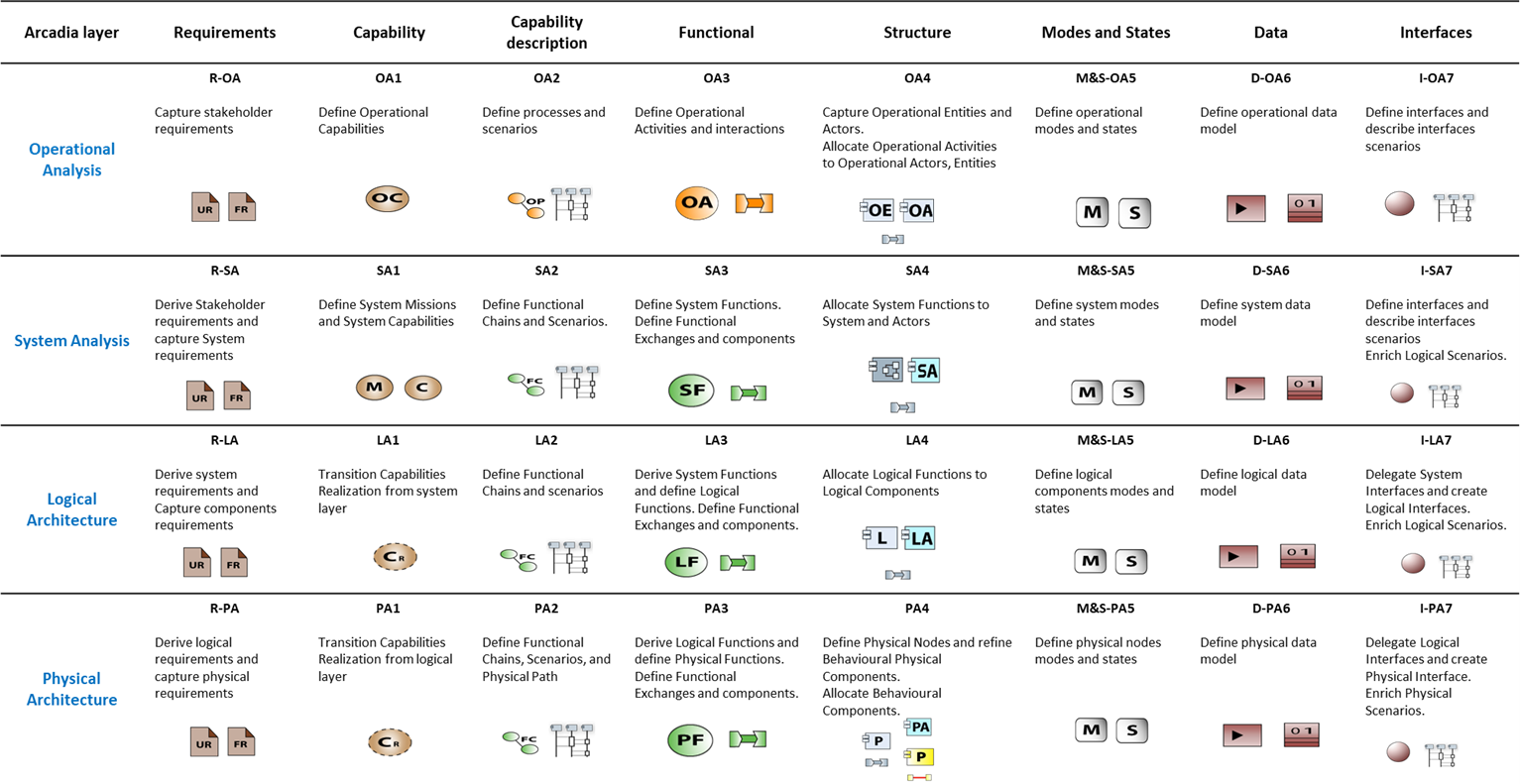
Arcadia is a tooled method devoted to systems & architecture engineering, supported by Capella modelling tool.
It describes the detailed reasoning to
It can be applied to complex systems, equipment, software or hardware architecture definition, especially those dealing with strong constraints to be reconciled (cost, performance, safety, security, reuse, consumption, weight…).
It is intended to be used by most stakeholders in system/product/software or hardware definition and IVVQ as their common engineering reference and collaboration support.
Arcadia stands for ARChitecture Analysis and Design Integrated Approach.
A series of online documents to dive into the principles and concepts of Arcadia:
Arcadia is a system engineering method based on the use of models, with a focus on the collaborative definition, evaluation and exploitation of its architecture.
This book describes the fundamentals of the method and its contribution to engineering issues such as requirements management, product line, system supervision, and integration, verification and validation (IVV). It provides a reference for the modeling language defined by Arcadia.
Jean-Luc Voirin, leader of the creation of the Arcadia method, along with some of the leaders on developing and deploying MBSE Arcadia & Capella practices in Thales. From right to left: Pierre Nowodzienski, Jean-Luc Voirin, Juan Navas, Stephane Bonnet, Frederic Maraux, Gerald Garcia, Philippe Fournies, Eric Lepicier.
Architecture as prime engineering driver
Arcadia, a model-based engineering method
Noticeable features of Arcadia
Definition of the Problem - Customer Operational Need Analysis
Formalization of system requirements - System Need Analysis
Development of System Architectural Design - Logical Architecture (Notional Solution)
Development of System Architecture - Physical Architecture
Formalize Components Requirements - Contracts for Development and IVVQ
Co-Engineering, Sub-Contracting and Multi-Level Engineering
Adaptation of Arcadia to Dedicated Domains, Contexts, Etc.
Equivalences and Differences between SysML and Arcadia/Capella
Watching on official platforms ensures you get the best audio-visual experience, including the immersive soundtrack composed by Himesh Reshammiya and the background score by Devi Sri Prasad.
: Kamal Haasan played ten distinct roles, ranging from a 12th-century Vaishnavite priest to a US-based scientist, and even a tall Caucasian man (Christian Fletcher). moviesda dasavatharam
Directed by K. S. Ravikumar and written by Kamal Haasan, Dasavathaaram is a milestone in Indian cinema. The film is famous for Kamal Haasan's portrayal of , ranging from a 12th-century priest to a modern-day scientist. Kamal Haasan’s Ten Avatars Watching on official platforms ensures you get the
The plot centers on scientist Govind (one of the ten roles) attempting to recover a deadly bio-weapon. The narrative spans various locations and times, exploring the "Butterfly Effect" (Chaos Theory) where minor actions lead to the 2004 tsunami. The film bridges themes of science and faith, featuring pioneering prosthetic work by Michael Westmore ⚖️ A Note on Piracy (Moviesda) Kamal Haasan’s Ten Avatars The plot centers on
(2008) is its complex story that explores how small actions can change the world. It’s a fascinating look at the "Butterfly Effect," where a scientist named Govind accidentally releases a deadly bioweapon and must stop it from destroying the world. Here is why the story is so "helpful" and unique:
Searching for "Moviesda Dasavatharam" typically refers to users looking for pirated versions of the film. Legal Alternatives:
: The film employed Hollywood makeup artist Michael Westmore to achieve the ten unique looks, pushing the boundaries of prosthetic technology in the Indian film industry at the time.